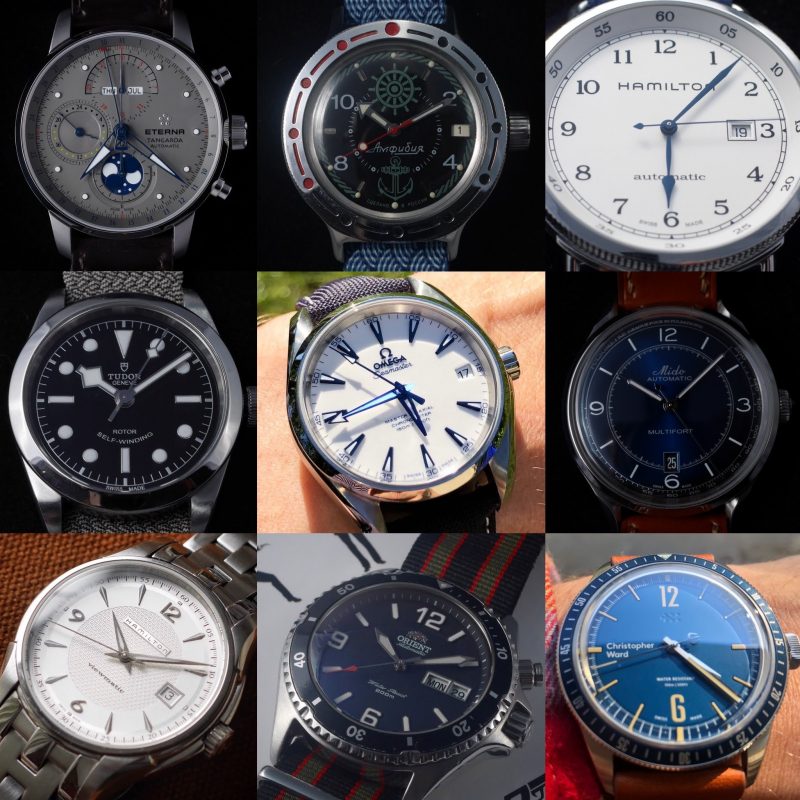

Recently in my consumption of watch content, I came across a nearly identical opinion expressed both in a prominent podcast and on a thread on Reddit.
On Ariel Adams’ Superlative podcast, he and Pascal Brandt were discussing the rise of watch e-commerce and had the following dialogue:
And last but not least on that topic, I would say people always love and will always love to enter a point of sale, whatever it is, boutique, retailer, to take the watch in their hands, you know.
E-commerce was born during the COVID crisis as an alternative to run the business, to compensate. But finally, this except if you sell a very low-priced watch is, which is okay, but for upper prices, no.
I totally agree. And I’ve noticed that, and I’ve said this many times, we live in an Internet-first world with watches, where people might learn about a brand or a model on the Internet first, may develop an interest in it. But ultimately, there needs to be some type of a real-world element.
They have to see it on someone’s wrist somewhere, in a shop or on a friend’s wrist, but they need to see it in order to make the decision to purchase it. The people who thought that the entire sales cycle could happen online, that was a delusional fantasy.
No, totally. I agree with you, totally. You want to have it in your hands.
You want the personal contact, physical contact, with a person, sales guy, sales lady. You want to chat, you want to speak with an espresso beside you. And that’s it.
It’s a material connection. It’s not immaterial, you know.
Just a day or two earlier, I had seen an r/Watches thread in which the poster expressed a similar sentiment:
After a month of deep-dive online research for my first “real” watch, I narrowed my options down to the Hamilton Khaki Field, the Tissot Gentleman, the Tissot Heritage 1938, and the Bulova Lunar.
Hamilton was at the top of my list because it seemed like the perfect everyday piece, something I could wear to work but also dress up when needed.
But when I finally saw the Hamiltons in person, I was honestly pretty underwhelmed. The online photos with perfect lighting make them look way better than they did on my wrist. I’m planning to give them another look before I write them off completely, but my first impression wasn’t great.
What surprised me most were the watches I didn’t expect to like. Some Citizens looked incredible in person, a few Seikos really impressed me, and the Tissot Le Locle looked amazing.
Moral of the story: online research is only a small part of watch hunting. Photos can be super misleading. Don’t make your final decision based solely on what you see online.
In both discussions, the conclusion was that a watch buyer wants and needs to see a watch in person before buying (except maybe for low-value purchases). The two reasons provided for this were: 1) to make sure the buyer likes the watch in person and not just in photos and 2) the interaction with the seller/salesperson provides some of the value the buyer is seeking in buying the watch.
I think this is probably true for most watch buyers, at least as to the first reason. I think the second reason is really only applicable in the context of sales by brands or authorized dealers where the buyer is paying full (or close to full) retail price for a high-dollar watch, and so wants the sales attention and little extras of the experience that are available when buying in person. But there are many watch buyers who don’t want to pay extra for attention that they also don’t want, but instead prefer that all their value go into the watch itself, often at a preowned price. Dealers like Topper, Porcello, 1916, Manfredi, etc., seem to have recognized this with their robust pre-owned online offerings where you get the security of buying from an established brick-and-mortar business but the value of buying pre-owned and online.
But returning to the first reason (seeing in person before you buy, to be sure you actually like the watch in the metal), while I agree this is generally true, it also doesn’t have to be. I’m a great example: I’ve bought over 70 watches over the last 15 years, but I’ve only seen 3 or 4 of them in person before buying. And those few I’ve seen were at the lower end of the cost spectrum of my collection.
Why have I been fine buying without trying (on)? And what can others learn from my experience?
Sometimes You Can’t Find a Watch To Try On
This has been the biggest reason for my willingness to buy without seeing in person. We have relatively few ADs where I live, so it can be difficult to actually find the watch to see in person. And even if you can, I have never felt great about going in to try on a watch that I don’t intend to buy from that seller.
Additionally, if you’re looking to buy a higher-end microbrands or lower-cost independent, you’re often looking at buying a watch that is rarely available to see before you order. Such was the case with my Kurono Tokyo Toki. If I wanted to buy it, I had to do so without any chance of seeing it prior.
It Helps to Start Small and Be Willing to Sell
If you’re going to get comfortable with buying higher-dollar watches unseen, I think you probably have to have a progression similar to mine. I started out by buying (and usually then selling) numerous sub-$200 watches, of all shapes and sizes. I would wear them for a few months or a couple of years, and then I would sell once I knew they weren’t for me. Over the past decade-and-a-half, I’ve gradually built up my price points. But beginning by buying and trying many smaller-dollar watches helped me to understand the finer points of design and sizing, what I liked and didn’t like, and what would or wouldn’t work for me. Once you’ve tried a couple of dozen different watches for a while, you get a great understanding for the significance of factors like watch thickness, lug-to-lug measurements, round versus square design, and lug shape that all help determine how a watch actually wears. As a result, by the time I was paying more for watches, I was rarely surprised by how a watch wore.
Find Actual Photos Everywhere You Can
Additionally, I’ve learned not to depend on the stock photos of the watch (which are often not so much photos as renders). Instead, I will scour reviews, Instagram, WatchCrunch, and anywhere else that I can find actual photos of the watch in a variety of situations and light. I try to find great photos and bad photos and everything in between, to try to give me a good idea of the way the watch may look in various conditions. Again, as a result, I am rarely surprised by how a watch looks in person — and when I am, it tends to look even better than I expected.
Did I Mention You Should Be Willing To Sell?
Look, if you’re not looking to have a single/few watch collection, or you’re not someone who always knew that the Speedmaster (or whatever) was the only watch for you, then the reality is that you’re likely going to want to keep adding pieces to your collection, and for many people this also means the value of the pieces you add is going to increase. So unless you’re wealthy and can afford to just keep adding, at some point you’re going to have to sell some pieces anyway to make room and raise funds for your next purchase. It is true that the risk of loss increases as your watches become more valuable, but the basics of safe selling remain the same. Also, as the value goes up, trading in a piece to an established pre-owned dealer also tends to become a more viable option.
Finally, even if you love a watch in the store or for the first year or two you own it, eventually something newer and shinier may come along and your initial ardor for the old watch may turn into a wish to switch it out for a new one. Trying on a watch is no guarantee that you’ll always love it, and that’s okay! It’s part of this hobby for many people, so you just have to get comfortable with moving that piece you no longer love along when the right time comes.
Update 12/31: Just a day after this post, a topic on the same subject started on Watchuseek. In the four pages of posts, you’ll find many similar thoughts as I offer above. But what was really interesting to me was that 74% of the respondents to the accompanying poll indicated that they had purchased 80% or more of their watches without seeing them in person first! I would not have expected the percentage to be that high, even on an online watch forum. But it does show that there will continue to be a place for online watch sales — not all of us are looking for the “in-person AD experience” for our purchases…we just want to buy an awesome watch.